Description
The old man entered with a compass in one hand and a parcel beneath his arm.
He paused before the shelf. Beside the Watcher sat his wife’s old watch—the one she had traded for the strange wristwatch she brought home. He knew it well.
“There you are,” he murmured.
Then the Watcher’s eyes turned toward him. A quiet happiness softened his face.
“Have you been here before?” the shopkeeper asked.
“No. But I think I’ve brought him to the right place.”
He glanced at her watch, as though it had come ahead to mark the way.
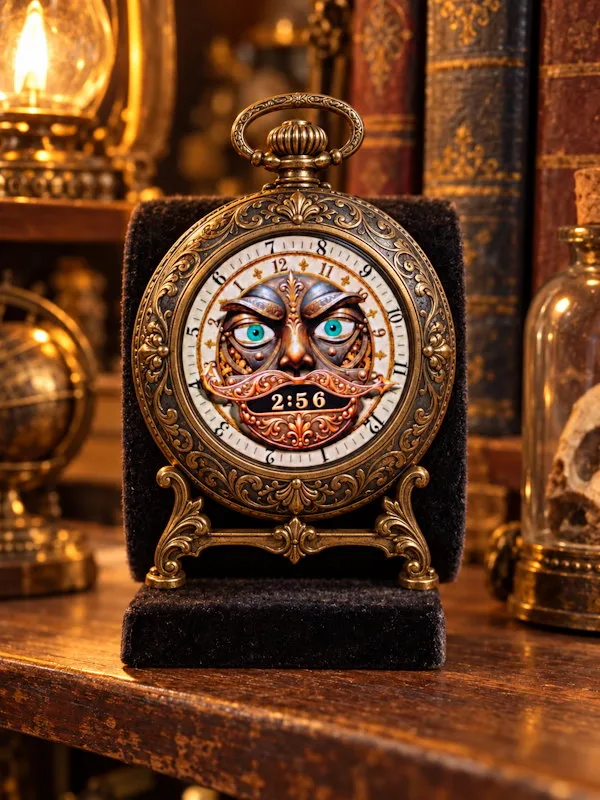
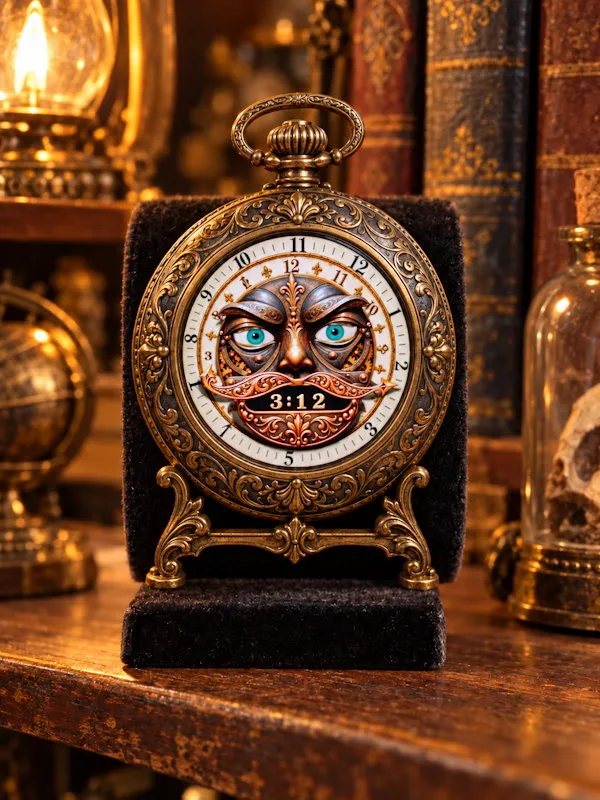
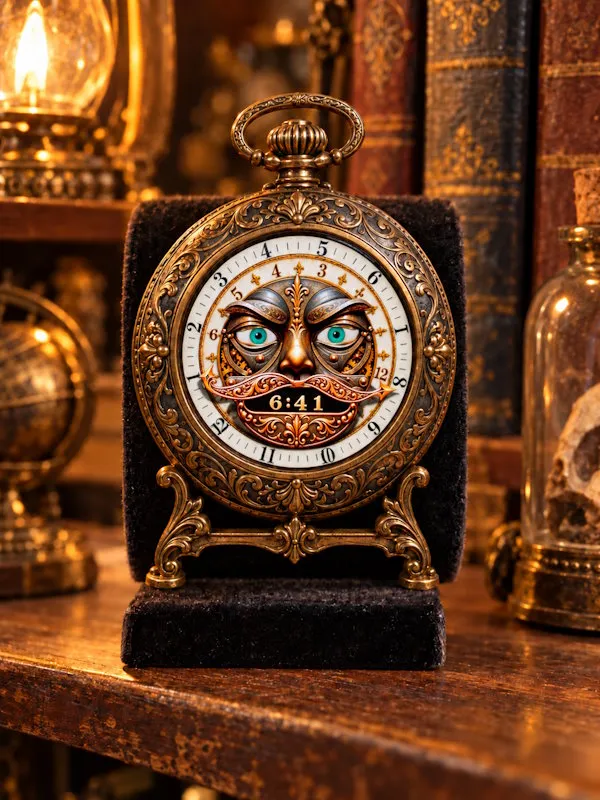
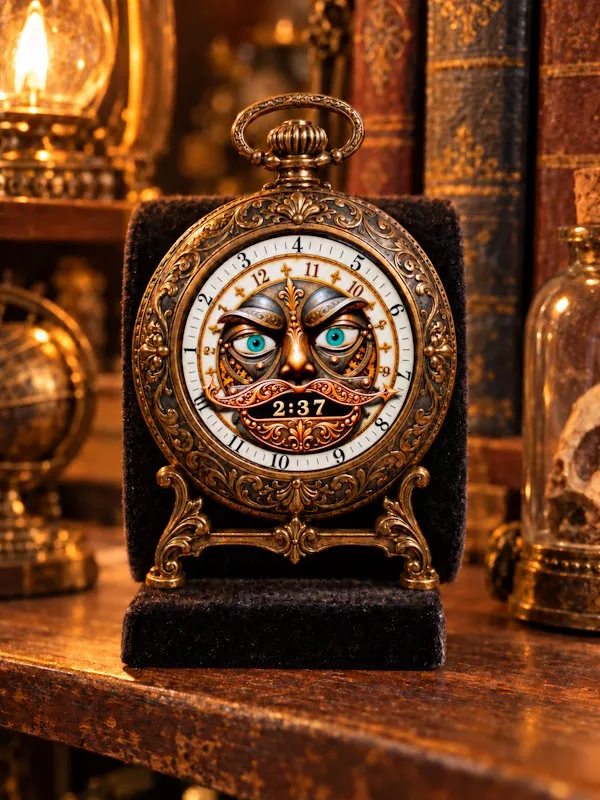
He unwrapped the parcel. Ivory rings surrounded an ornate metal face. Its eyes studied the shopkeeper, then searched beyond him.
“My teacher gave him to me when I finished my apprenticeship. Called him the Horologist.”
“Tell me.”
Long ago, a cruel king stole a throne. Those who opposed him disappeared. So did those who asked where they had gone.
One day, he summoned the horologist who maintained the great royal clock.
He wanted the eyes of his victims placed inside clocks.
“He wanted them to watch him live,” the old man said. “And never speak against him again.”
The horologist refused.
But the coronation anniversary was approaching, and the king needed his great clock repaired. He calmly reminded the craftsman to finish his work.
That night, the horologist told his wife. She held his trembling hands until it grew late, then went to bed.
Unable to sleep, he remained in his workshop.
At sunrise, he went upstairs.
She was gone. Her clothes remained. Nothing was disturbed.
By evening, he was begging at the palace gates.
No one let him enter.
“The king found someone willing to make his clocks,” the old man continued. “The horologist spent his life searching for them.”
Eventually, the king fell in battle with most of his followers. His successor ordered his possessions destroyed.
Then he saw the clocks watching him.
Unable to bear their destruction, he spared them. Some were returned to families. Others disappeared into markets and collections.
Later craftsmen copied their moving eyes. What had been an instrument of cruelty became a novelty, and the originals were lost among imitations.
“Some families kept them,” the old man said. “And passed down the warning with them.”
The shopkeeper glanced at the Watcher. He remembered its hooded visitor, the face he could never see, the care with which he had handled it.
Perhaps he had carried a relative into the shop.
“And the horologist’s wife?”
“Never found.”
“But he believed…”
“Yes. He believed he would recognize her eyes.”
The old man opened a worn notebook.
“My teacher copied his journal. His teacher did the same.”
Its pages held journeys and names. Near the end was a mechanism within the face resting on the counter.
The final entry read:
My hands will not serve much longer. My eyes are sound.
There are places I have not looked.
“He put himself inside?” the shopkeeper whispered.
“He intended to. I cannot prove he succeeded.”
The Horologist looked toward the door.
“But I’ve kept him most of my life. He studies everyone who comes near. He is always searching.”
The shopkeeper placed the Watcher beside him.
Their eyes shifted toward one another, then back toward the room.
“My wife and I have no children,” the old man said. “No one to leave him to. Perhaps things find each other here.”
He touched the brass case.
“I’ve had nearly fifty years beside her. Most mornings, I wake first. I wait until she opens her eyes and asks why I’m staring.”
His voice softened.
“I would like him to have his morning.”
“What would you ask in exchange?”
“Nothing. Only put him where he can see who comes in.”
“And if another arrives, I’ll let him look.”
The old man left the journal and collected the compass.
“She’ll be waiting. I promised to be home for supper.”
As the door opened, the Horologist’s eyes moved beyond him to the street.
The shopkeeper left the lamp above the two clocks burning.
What is new
A Note from the Shopkeeper
A few things worth knowing before you take him home.
He will spend some time studying you. There is no need to hold still. He seems to prefer accompanying someone who has places to go.
READING THE HOURS
His moustache is more useful than it first appears.
Read the inner hour ring at the upturned tip on your left, just below nine o’clock. The ring moves gradually between numbers; take the hour already passed.
Read the outer minute ring at the tip on your right, slightly below three o’clock. Each numbered position represents five minutes: 1 means :05, 3 means :15, 6 means :30, and 12 means :00. The small marks count individual minutes.
Should you prefer a direct answer, his mouth displays the same time as a dgital reading. He keeps twelve-hour time, even if your watch is set to twenty-four.
ABOUT HIS EYES
Their colour follows your recent heart-rate history relative to your resting rate. At lower activation, expect sapphire blue. As activation rises, the colour moves through teal, amber, and copper. A rising heart-rate trend adds a little warmth.
These changes are gradual. He takes his time forming an impression.
Outdoor temperature adds a subtle tint: cooler air lends blue, warmer air a touch of peach. His eyes do not predict rain or change colour with the seasons.
When usable heart-rate data is available, stress history gently softens the richness of the colour, while Body Battery makes it slightly brighter or dimmer.
HIS EXPRESSIONS
Changes in your step count help him notice movement. While you are active, his glances become quicker and wider. During periods of observed inactivity, his lids may settle and his blinks sometimes linger.
An elevated, rising heart rate can add a little liveliness when your steps already show that you are moving.
His expressions are an artistic response to the available data, rather than a reading of your mood or tiredness. I would not take an occasional squint personally.
A WORD ABOUT HIS ENERGY
The charge remaining in your watch also affects his eyelids. Below half charge, they gradually grow heavier as the battery falls. Movement may lift his spirits, but it cannot refill the battery.
Body Battery influences the brightness of his eyes; the watch’s actual charge contributes to their droop. They are different things, despite the similar names.
WHEN HE WITHDRAWS
On waking, he fades into view, stays fully visible for about twelve seconds, then fades to a small, dim monogram. If the watch enters sleep sooner, he withdraws immediately.
His animations pause while he rests. The sleeping display shows the monogram, not the time; wake the watch to consult him again.
If a reading is missing or becomes stale, its influence falls away. Without usable heart-rate history, his eyes settle toward teal, with a temperature tint if that information remains available.
Give him time to become acquainted with you.
And should you notice him looking past your shoulder toward someone approaching, let him look.
—The Shopkeeper
Screenshots